Table of Contents
- Why Local Community Groups Beat Generic Event Listings
- Community Centres in Dacorum: Where to Start
- How to Meet New People in Hemel Hempstead: A Step-by-Step Guide
- What’s On in Hemel Hempstead Community Calendar: Your Weekly Guide
- Hobby Groups and Interest Clubs: From Badminton to Board Games
- Befriending, Volunteering and Peer Support: Building a Network
- Cost-of-Living Friendly Socialising and Getting There
- Accessibility and Inclusivity: What to Check Before You Commit
- Conclusion: Your Next Step to Community Engagement
- Frequently Asked Questions
Last Updated: October 2, 2026
Why Local Community Groups Beat Generic Event Listings
Generic event listings tell you what exists, but rarely whether a room is step-free, who the group skews towards, or whether you can turn up alone without feeling awkward.
This guide from What’s On In Hemel Hempstead covers the practical route into local social life: where to start, how to meet people without forcing it, and how to keep cost and travel manageable.
Below, we’ll walk through the community centres, hobby clubs, volunteering networks and low-cost social options that make up the town’s social infrastructure, plus a step-by-step plan for starting from zero.
The fastest route into local social life is not a big event. It is a small, regular group that meets weekly, in a venue you can reach easily, at a time you can protect.
Community Centres in Dacorum: Where to Start
Community centres in Dacorum are the backbone of local social life, yet most people overlook them, assuming they are only for booked private functions. In practice, many run weekly clubs, coffee mornings, exercise sessions and hobby groups anyone can join, often for a small fee or drop-in contribution.
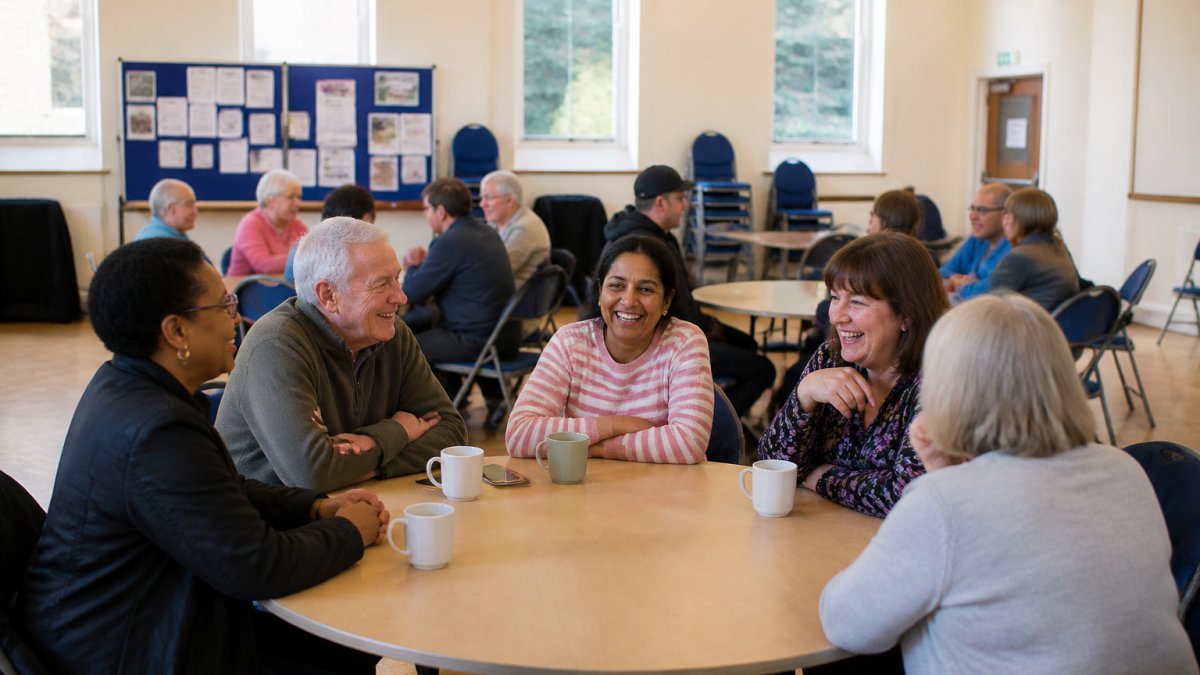
Check what your nearest centre actually hosts rather than what you assume. Entrance-hall notice boards are usually more current than any online listing.
A common mistake is only looking at the centre closest to home. One a short bus ride away may fit your interests far better, and transport access often decides whether you keep going after week three.
Ask at the reception desk which groups have space right now. Popular clubs fill quietly, and staff usually know which ones are actively welcoming new members this month.
How to Meet New People in Hemel Hempstead: A Step-by-Step Guide
Most guides tell you to “put yourself out there”. That is not a plan. What works is a short, repeatable process with a script for the awkward parts, the phone call, the first ten minutes, and the moment you decide whether to return.
Here is the version that tends to stick.
Step 1: Pick one interest, not five
Choose a single activity you already enjoy or did in the past. Conversation has a natural starting point when you are both holding a badminton racket or a pair of secateurs. If you cannot decide, pick the one you would happily attend even if you spoke to nobody.
Step 2: Find two groups for it, one weekly, one monthly
Two gives you a fallback without spreading you thin. A weekly group builds familiarity fast; a monthly one is easier to protect when work or caring responsibilities bite. Check community centre notice boards, library foyer boards and leisure centre club directories, usually more current than any single online listing.
Step 3: Message or call before you go
This is the step most people skip, and it removes the most anxiety. A short message is enough:
“Hello, I’m interested in the Tuesday session. I haven’t been before. Do I need to book, what should I bring, and is it okay to just turn up?”
A good organiser will answer all three. If nobody replies within a week, treat that as useful information and move to your second group.
Step 4: Know what the first ten minutes look like
Almost every group starts the same way: people arrive, hover near the door or the kettle, and wait for the session to begin. Your job is not to work the room, just arrive, say hello to whoever is nearest, and let the activity do the rest.
Three things help:
- Arrive on time, not early. Early arrivals expose the gap before the group has formed.
- Ask one open question. “How long have you been coming?” works better than “Is this seat taken?”
- Give yourself permission to leave after the session. You are not obliged to go to the pub afterwards on visit one.
Step 5: Attend three times before deciding
The first visit is always slightly awkward, for everyone, not just you. The second is where faces become familiar. The third is where it clicks. Most people quit after one, which is precisely why the group never gets the chance to feel like theirs.
Step 6: Exchange one contact
A single phone number, a group chat invite, or a “see you next week” said to a named person turns an activity into a relationship. One contact is enough. You do not need to collect the whole room.
If you are socially anxious, tell the organiser in advance. Most will meet you at the door, introduce you to one person, and pair you with someone for the first session. This is a normal request, not an imposition, organisers deal with it regularly.
The second and third visits matter far more than the first. Plan for three before you judge whether a group fits.
What’s On in Hemel Hempstead Community Calendar: Your Weekly Guide
A community calendar is only useful if it reflects what is genuinely happening this week, not last season. Local listings go stale quickly, so check a curated local guide rather than relying on a single source.
What’s On In Hemel Hempstead exists for exactly this reason: it brings local events, activities and venue information into one place, so you are not cross-referencing five sites to plan a Tuesday evening.
Here is a simple weekly rhythm that works for most people:
| Day | What to check | Typical activity type |
|---|---|---|
| Sunday | Week ahead listings | Events, one-off workshops |
| Monday | Regular club times | Hobby groups, exercise sessions |
| Wednesday | Weekend preview | Day trips, family activities |
| Friday | Last-minute options | Social gatherings, drop-ins |
Hobby Groups and Interest Clubs: From Badminton to Board Games
Hobby groups and recreational clubs are where mutual interest does the social work for you.
Badminton, walking groups, choir, photography, tabletop gaming, gardening and craft clubs all operate across the area, and most welcome beginners.
Membership fees vary widely by club and venue, so ask directly rather than assuming. Some charge annually, others per session, and many waive the fee for a first taster visit.
Sport England’s guidance on finding local clubs and activity
Befriending, Volunteering and Peer Support: Building a Network
Befriending services, volunteering and peer support groups build connection through shared purpose rather than shared pastime.
Volunteering is the lowest-pressure option. A regular shift at a charity shop, community garden or food project gives you a defined role, a reason to turn up, and colleagues you see weekly.
The volunteer network in any town runs on reliability more than enthusiasm. Committing to one hour a fortnight and actually showing up beats a grand gesture you cannot sustain.
Do not sign up for three volunteering roles at once. Overcommitting in the first month is the most common reason people drop out entirely by month three.
Cost-of-Living Friendly Socialising and Getting There
Cost is the quiet reason many people stop socialising, and transport is the second. Both are solvable with planning.
Free and low-cost options are more plentiful than most expect: library groups, park walking clubs, community centre coffee mornings and volunteer shifts cost little or nothing.
On transport, choose groups on a route you can use reliably in the evening and in bad weather.
| Barrier | Practical fix | Why it works |
|---|---|---|
| Membership cost | Ask about per-session or taster rates | Removes the annual commitment risk |
| Travel | Pick a venue on a direct bus route | Keeps attendance sustainable in winter |
| Time | Choose one fixed weekly slot | Protects the habit from drifting |
| Confidence | Attend with a friend the first time | Lowers the barrier to walking in |
GOV.UK guidance on local bus services and travel concessions
Accessibility and Inclusivity: What to Check Before You Commit
Accessibility is the detail most listings omit, and often the single factor deciding whether a group becomes a long-term fixture or a one-off visit you never repeat. Treat it as a checklist, not a vague hope.
The physical access check
Before you commit, confirm four things with the organiser or the venue:
- Step-free entry, not just a ramp at the front door, but a route from the pavement to the room you will actually be in. Older community halls sometimes have a level entrance and then a stepped corridor.
- Accessible toilet, on the same floor as the activity, and unlocked during the session. A key held at reception is a different experience from a door you can open yourself.
- Seating and pacing, chairs with backs, the option to sit out a round, and a session length that does not assume everyone can stand for two hours.
- Parking and drop-off, a bay close to the entrance, or a lay-by where someone can drop you without blocking traffic.
The sensory and neurodivergent check
Physical access is only half of it. If you are autistic, have ADHD, or find busy rooms draining, ask about:
- Noise levels, a hall with a hard floor and no soft furnishings amplifies everything. Ask whether the group meets in a carpeted room or a smaller side room.
- Lighting, flickering fluorescents are a common problem in older venues. Ask whether the room has natural light or whether lamps are used.
- A quiet space, a corridor, a side room, or even a designated chair away from the main group where you can step out for ten minutes without it being noticed.
- Structure and predictability, groups that publish a running order, start on time, and finish on time are far easier to settle into than loose drop-ins.
- Numbers, a group of twelve feels very different from a group of forty. Ask roughly how many usually attend.
How to ask without it feeling like a complaint
A short, factual message works best:
“Before I come along, is the room step-free from the entrance, is there an accessible toilet on the same floor, and roughly how many people usually attend? I also find busy rooms a bit much, so is there anywhere quieter I could sit?”
A good group will answer honestly, including where it falls short. That honesty is itself a useful signal: organisers who say “the toilet is down a step, but we can help” are usually the ones who will look out for you on the night.
What a genuinely inclusive group looks like
Inclusive events are rarely the ones that advertise themselves as inclusive. They are the ones where the organiser has thought about arrival, seating and pacing in advance, a named greeter at the door, a chair near the exit, a break announced at a set time, and no pressure to stay for the whole session.
Do not assume a venue’s website is accurate on access. Step-free routes, lift maintenance and toilet availability change. A two-minute phone call to the venue, not the group, is the most reliable check.
GOV.UK guidance on the Equality Act and reasonable adjustments for community venues
Conclusion: Your Next Step to Community Engagement
Building a local social life rarely happens through one big decision. It happens through a small, repeated commitment to a group that fits your interests, budget and route home.
What’s On In Hemel Hempstead brings local events, activities, dining and venue information together in one place, so you can compare what is on without juggling multiple listings. The platform covers sports and fitness through to wildlife attractions, keeps local news and weather in one spot, and offers advertising space for local businesses and tradespeople at competitive rates.
Get started with What’s On In Hemel Hempstead and find the group that fits your week.
Frequently Asked Questions
How can I find local community groups in Hemel Hempstead?
Start with community centres in Dacorum, such as the Old Town Hall or the Sunlight Centre, which host everything from coffee mornings to art classes. Check their noticeboards and websites for weekly schedules. For a broader view, use a local directory that brings together hobby groups, volunteer networks and social gatherings in one place. Many groups also have Facebook pages where you can message an organiser before attending. Libraries and council offices often keep lists of recreational clubs and activity scheduling details.
Are there social clubs for adults in the Dacorum area?
Yes, Dacorum has a wide range of social clubs for adults, including walking groups, book clubs, photography circles and sports teams. Many meet weekly at community hubs or leisure centres. Some focus on specific interests, like amateur dramatics or gardening, while others are purely social, such as lunch clubs or pub meetups. Membership fees vary, but many are free or low-cost. Look for notices in local cafes, libraries or online community calendars to find one that matches your interests.
What resources are available for finding social gatherings in Hertfordshire?
Hertfordshire has several resources: local council websites list community events, volunteer centres advertise opportunities, and libraries often host coffee mornings and clubs. Online directories, like What’s On In Hemel Hempstead, curate events, hobby groups and befriending services in one place. You can also check noticeboards in supermarkets, community centres and GP surgeries. For those new to the area, a step-by-step approach, starting with one regular activity, can make it easier to build connections.
How do I join local hobby or interest groups in my area?
First, identify what you enjoy, whether it’s badminton, board games, or gardening. Then search online for groups in Hemel Hempstead, or visit a community centre and ask about their timetable. Many groups welcome drop-ins, so you can try before committing. If you’re unsure, contact the organiser via email or social media to ask about membership fees and accessibility. Some groups have waiting lists, so it’s worth enquiring early. Volunteering is another way to meet people with shared interests.