
Table of Contents
- Step 1: Set a Realistic Budget Before Anything Else
- Step 2: Choose a Destination and Lock In Travel Dates
- Step 3: Appoint a Group Leader and Assign Roles
- Step 4: Build Your Group Outing Planning Checklist
- Best Apps for Group Trip Planning in 2026
- How to Plan Group Outings Without the Drama
- Legal, Safety, and Insurance Considerations
- Conclusion
Last Updated: August 17, 2026
Group trips often fall apart before they begin due to conflicting schedules, clashing budgets, and unclear decision-making. This guide from What’s On In Hemel Hempstead covers the full process: from setting a budget that nobody resents to resolving disagreements without ruining friendships. We’ll show you exactly how to coordinate a group outing from first idea to final sign-off, including the soft skills that most travel planning content ignores entirely.
Group outing planning is the process of coordinating logistics, preferences, budgets, and personalities across multiple people to create a shared experience that works for everyone involved.
Step 1: Set a Realistic Budget Before Anything Else
The biggest mistake most groups make is choosing a destination before agreeing on money. By the time someone mentions the price, half the group is already emotionally committed to a plan they cannot afford.
Start with a frank conversation. Ask everyone to name a comfortable per-person spend before any destination is discussed. This prevents the social awkwardness of someone having to back out later because costs escalated beyond what they signalled was manageable.
How to Manage Group Outing Budgets Fairly
Managing group outing budgets fairly means working from the lowest comfortable spend in the group, not the average. If one person can comfortably spend £200 and another can spend £80, designing a trip around £140 leaves the second person in a difficult position. Build around the floor, not the ceiling, and let those with more flexibility contribute to shared upgrades if they choose.
Define three budget tiers early: essential costs (transport, accommodation, entry fees), optional extras (meals out, upgrades, activities), and an emergency buffer (typically 10-15% of the total per-person cost). According to the Money Advice Service guidance on group travel finances, financial disagreements are among the most common causes of conflict in group travel situations.
Splitting Costs and Tracking Shared Expenses
Splitting costs fairly requires more than dividing a total by the number of people. Some members may opt out of specific activities; others may have dietary needs that affect meal costs. Track every shared expense from the start using a shared spreadsheet for smaller groups or dedicated expense-tracking tools for larger parties.
Agree the split method before the trip, not during it.
| Expense Type | Split Method | Notes |
|---|---|---|
| Accommodation | Equal per room/bed | Adjust for room type differences |
| Shared meals | Equal or itemised | Agree upfront which approach |
| Transport | Per seat used | Opt-outs should not pay |
| Optional activities | Pay-as-you-go | Never pool for activities not all attend |
| Emergency buffer | Equal contribution | Refund unused portion post-trip |
Step 2: Choose a Destination and Lock In Travel Dates
Destination selection is where group dynamics become visible. The mistake is opening with a blank canvas and asking "where should we go?" Instead, have each person submit two or three destination ideas anonymously before any group discussion. From those submissions, narrow to a shortlist of three.
Reaching Consensus When Everyone Has Different Preferences
Use a weighted preference system: each person ranks the shortlisted destinations from most to least preferred. The destination with the highest combined ranking wins. For travel dates, use a shared availability tool where each person marks available dates. Aim to find a window where the majority can attend, then give those who cannot make it a clear deadline to flag constraints.
When finalising travel dates, book any accommodation or transport that has a free cancellation window as soon as the majority confirms. This secures availability without financial risk while remaining members confirm.
Once dates are agreed, assign a booking deadline. Decisions that have no deadline do not get made.
Step 3: Appoint a Group Leader and Assign Roles
Every successful group outing has a single point of coordination. Appointing a group leader does not mean one person makes all the decisions, it means one person owns the process.

The group leader’s role is to chase confirmations, hold deadlines, and escalate unresolved decisions to the group. Pair this with distributed roles to spread the load: accommodation lead, transport lead, activities lead, and finance lead. Assigning roles gives people ownership and reduces burnout.
Avoid assigning the finance lead role to the same person as the group leader. Separating these responsibilities prevents disputes about whether the coordinator is making decisions that favour their own budget.
Step 4: Build Your Group Outing Planning Checklist
A group outing planning checklist is the operational backbone of any well-run trip.
Six or more weeks before:
- Agree budget range per person
- Collect destination preferences
- Confirm travel dates with all members
- Appoint group leader and assign roles
- Open a shared group chat or planning workspace
Two to four weeks before:
- Book accommodation (with free cancellation where possible)
- Book transport
- Research and shortlist activities
- Confirm dietary requirements and accessibility needs
- Check travel insurance options for all members
One week before:
- Distribute final itinerary to all members
- Confirm all bookings and save confirmation references centrally
- Share emergency contact details within the group
- Confirm any required identification or documentation
On the day:
- Designate a meeting point and backup meeting point
- Confirm group leader has all booking references
- Share a group contact number for anyone who gets separated
Creating a Shared Itinerary Everyone Can Access
A shared itinerary is a single document that contains every confirmed booking, timing, address, and contact number for the trip. One person should own the document while everyone can view it. Avoid editing permissions for all members, as conflicting changes create confusion. Structure the itinerary by day and time, with 20-30 minutes of buffer built in per half-day, as groups consistently underestimate travel time between activities.
Accessibility, Dietary Needs, and Inclusivity Planning
Accessibility planning means checking that every venue, transport option, and accommodation choice works for all members of the group, including those with mobility limitations, sensory sensitivities, or medical requirements. The Equality Act 2010 guidance on service accessibility places obligations on service providers, but check directly with venues rather than assuming compliance.
Dietary requirements should be collected at the same time as budget information, not the day before a restaurant booking. Flag requirements to venues in advance and confirm they can be accommodated. Inclusivity planning also means considering whether all activities are genuinely accessible to all group members in terms of physical ability, cost, and personal comfort.
Best Apps for Group Trip Planning in 2026
The right planning tools reduce coordination overhead significantly.
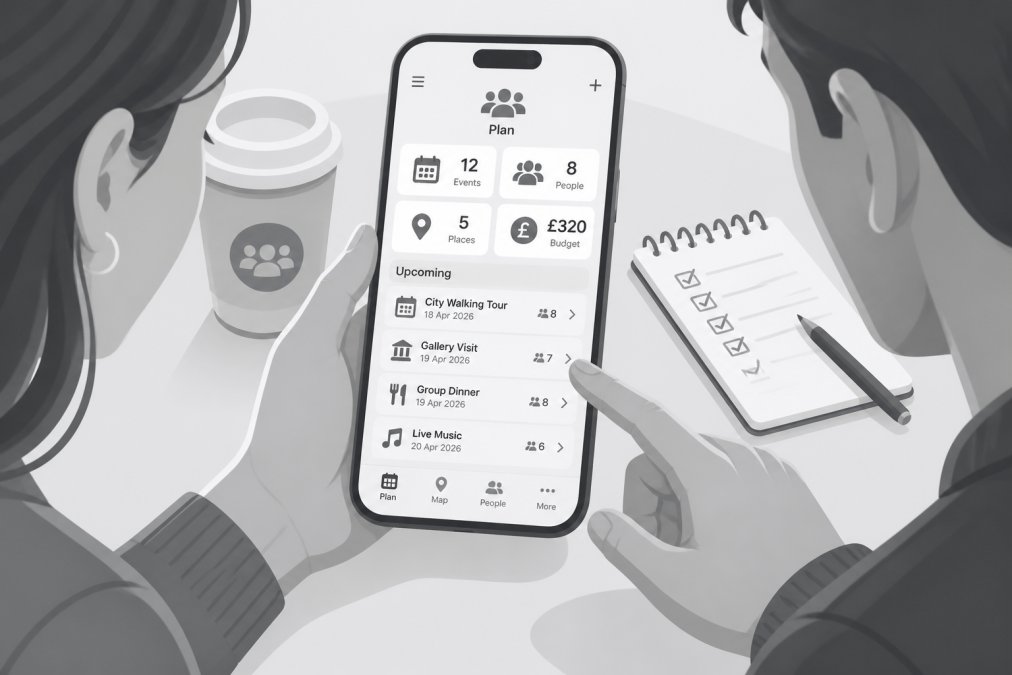
For expense tracking and cost splitting: Dedicated group expense apps allow members to log costs as they occur, split bills by custom amounts, and settle balances at the end of the trip.
For itinerary management: Collaborative itinerary tools let the activities lead build a day-by-day plan that all members can view on their phones, with offline access included.
For scheduling and availability: Shared calendar tools or availability polling apps solve the travel dates problem efficiently.
For group communication: A dedicated group chat keeps trip-related messages separate from everyday conversations.
The best apps for group trip planning are those the whole group will actually use. A sophisticated tool that half the group ignores is worse than a shared notes document everyone checks. Prioritise simplicity and universal access over features.
For local activity discovery and event listings when planning a group getaway in the Hemel Hempstead area, What’s On In Hemel Hempstead provides a curated guide to attractions, events, and dining options that simplifies the activities research phase considerably.
How to Plan Group Outings Without the Drama
The logistics of group travel are solvable. The interpersonal dynamics are harder. The core tension in any group outing is between individual preferences and collective compromise. People who feel steamrolled disengage; people who feel ignored withdraw.
Conflict Resolution Frameworks for Group Travel
Establish a pre-agreed set of rules for how disagreements will be handled before they arise. Three approaches that work in practice:
- The ranked vote: All disputed decisions go to a ranked-choice vote. The result is binding.
- The opt-out rule: Any member can opt out of any activity without explanation or social pressure.
- The cooling-off protocol: For interpersonal disputes during the trip, pause for one hour before discussion. Most disagreements dissolve in that window.
According to ACAS guidance on conflict resolution in group settings, pre-agreed processes reduce the intensity of disputes because the framework itself depersonalises the decision.
Post-Trip Reconciliation and Expense Sign-Off
Post-trip reconciliation is the process of finalising all shared expenses, settling outstanding balances, and formally closing the group’s financial accounts after the trip ends. The finance lead should produce a final expense summary within 48 hours of returning. All members confirm or dispute the figures within 72 hours, and outstanding balances are settled within one week. A clean sign-off prevents lingering resentment and makes future group outings easier to organise.
Legal, Safety, and Insurance Considerations
Group travel carries legal and safety responsibilities that individuals travelling alone do not face in the same way.
Travel insurance: Individual travel insurance policies may not cover group activities or shared bookings. Check whether each member’s policy covers the specific activities planned. The Association of British Insurers guidance on group travel insurance recommends reviewing policy exclusions before booking rather than after an incident.
Accommodation liability: When booking shared accommodation as a group, the named booker typically carries contractual responsibility for the property. Ensure the group understands the terms, including damage deposits and cancellation policies.
Safeguarding and duty of care: For groups that include minors or vulnerable adults, the organiser has a duty of care that extends beyond general good sense. Confirm the venue’s safeguarding policies and ensure appropriate supervision ratios are in place.
Emergency planning: Every group outing should have a designated emergency contact outside the group, a list of any members’ medical requirements or allergies held by the group leader, and a clear protocol for what happens if a member becomes separated or unwell.
Planning a group outing well is genuinely difficult, and the gap between a memorable trip and a logistical disaster often comes down to preparation made weeks in advance. What’s On In Hemel Hempstead helps with the activities discovery phase, providing a comprehensive guide to local events, attractions, and dining options to make building your itinerary straightforward. Explore the listings, use the group outing planning checklist in this guide, and get started with What’s On In Hemel Hempstead to find the activities that will make your next group getaway worth the coordination effort.
Frequently Asked Questions
Is there an app to organise a group trip?
Several apps make group trip planning easier. Tools like Splitwise handle shared costs and expense tracking, while Google Docs or Notion work well for building a shared itinerary. For scheduling, Doodle lets everyone vote on travel dates without endless back-and-forth messages. A group chat on WhatsApp or Telegram keeps communication in one place. The best approach is combining one budgeting tool, one itinerary tool, and one group chat rather than relying on a single platform to do everything.
What should I include in a group trip planning checklist?
A solid group outing planning checklist should cover: agreed budget per person, chosen destination and travel dates, accommodation booked and confirmed, a shared itinerary with activity slots, dietary and accessibility requirements noted, travel insurance arranged, emergency contact details shared, and a clear method for splitting payments. Adding a post-trip expense reconciliation step ensures no one is left chasing money after the group getaway ends. Sharing the checklist in your group chat means everyone stays accountable.
How do you manage group outing budgets effectively?
Start by agreeing on a per-person budget before any booking takes place. Collect contributions upfront rather than chasing reimbursements later. Use an expense-tracking app so every payment is visible to the group. Assign one person to handle shared costs like accommodation and group activities, then reconcile at the end. Build a small contingency fund of around 10% of the total budget to cover unexpected costs. Transparent tracking prevents disputes and keeps group dynamics positive throughout the trip.
How do you ensure a group outing remains inclusive for all participants?
Inclusivity planning starts at the destination selection stage. Ask every participant about mobility needs, dietary requirements, and any activities they cannot join before finalising the itinerary. Check venue accessibility ratings and confirm step-free access where needed. Build free time into the schedule so individuals can opt out of specific activities without feeling excluded. Keeping the group size manageable, typically under twelve people, also makes it far easier to accommodate different personalities and travel preferences without anyone feeling overlooked.
This article was written using GrandRanker